
Right, so the headsets are no longer just a tech demo at trade shows. Apple’s Vision Pro has been in people’s living rooms, Meta Quest 3 is being handed out at Christmas, and developers across the UK are quietly panicking because their entire skill set is built around a flat rectangle. If you’ve spent years perfecting pixel-perfect layouts on 1440p screens, the shift to volumetric, three-dimensional interface design feels like someone changed the rules mid-game. Which, to be fair, they have.
Spatial design for UI designers isn’t some distant futurism anymore. It’s a present-tense career skill. And the good news is that your existing knowledge doesn’t get binned. It gets extended, sometimes stretched uncomfortably, but extended nonetheless.
What Spatial Design Actually Means (Not the Buzzword Version)
Let’s be precise. Spatial design, in the context of mixed reality and extended reality (XR), refers to the practice of designing interfaces, information, and interactive elements that exist within three-dimensional space, rather than constrained to a flat screen surface. Instead of a canvas with X and Y axes, you’re working with X, Y, and Z. Depth is now a design variable.
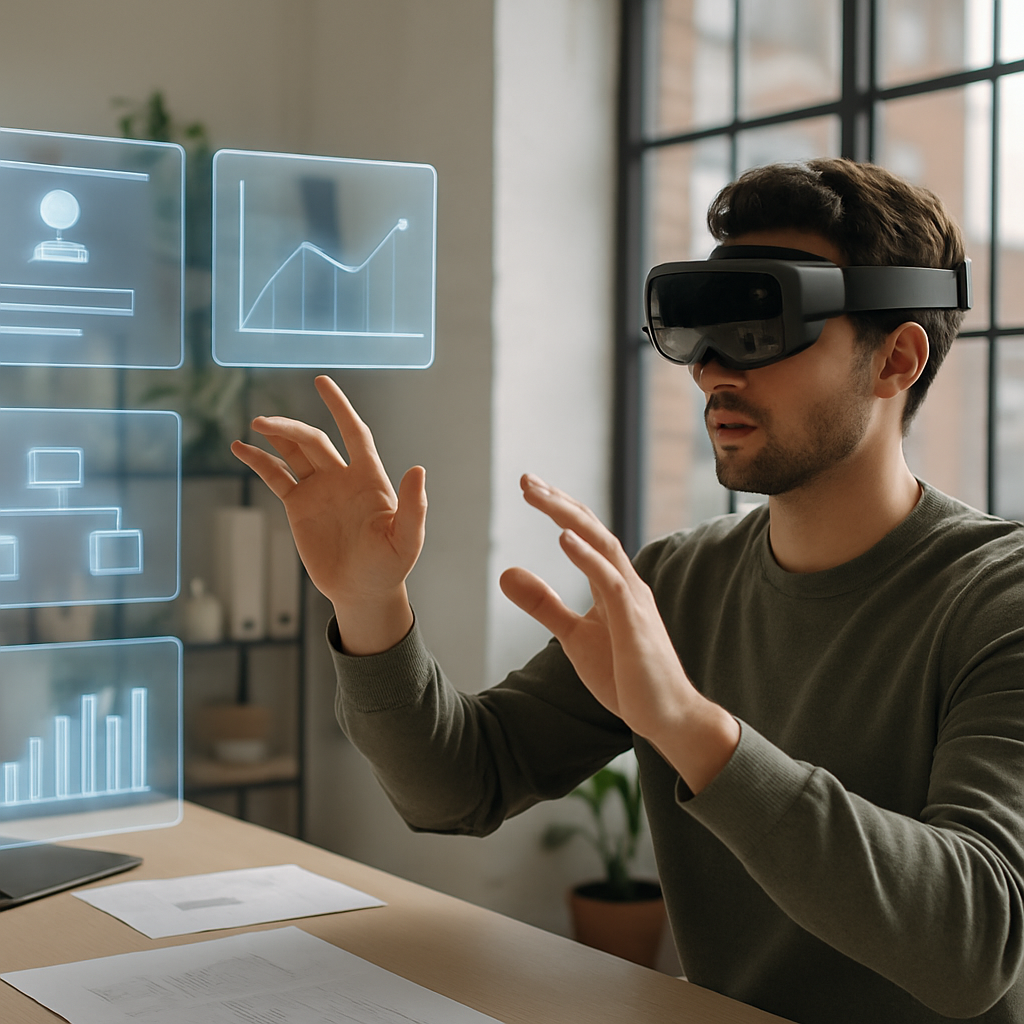
In a mixed reality headset like Vision Pro, a UI panel doesn’t sit inside a monitor. It floats in your kitchen. Users can walk around it, look at it from an angle, or physically reach out to interact. That changes almost everything about hierarchy, readability, affordance, and spatial audio as a design layer. The BBC’s technology coverage has tracked how these devices are moving from novelty to genuine productivity tools, which tells you the design profession needs to catch up quickly.
The Core Principles That Actually Transfer From Screen Design
Here’s what I’d tell any screen-based UI designer who’s feeling overwhelmed: your instincts about hierarchy, contrast, and cognitive load are still completely valid. Spatial design doesn’t throw those out. It complicates them.
Visual hierarchy still matters enormously. In fact, it matters more, because users can now look in any direction. You can’t assume their gaze is somewhere in the centre-top third of a fixed canvas. Designing for spatial environments means thinking about where attention naturally falls in three-dimensional space, which ties directly to concepts from environmental design and wayfinding, disciplines that graphic designers have largely ignored until now.
Typography principles carry over too, but with major caveats. Text rendering in XR headsets is improving fast, but legibility at distance and from off-angles is genuinely different from screen typography. Font weights that work at 16px on a Retina display can fall apart when a text panel is floating 1.2 metres away from a user’s face. You need to think in angular resolution, not pixels. That’s a mindset shift.
Colour and contrast remain critical. In passthrough mixed reality, your UI layers over a real physical environment that you can’t control. That cream-coloured wall behind a floating button might destroy your contrast ratio entirely. Designing for spatial contexts requires building in far more contrast tolerance than you’d typically use on a screen.

What Doesn’t Transfer and What You Need to Learn Fresh
Scrolling is mostly dead, and that’s going to take some unlearning. The entire paradigm of infinite scroll, long-form vertical layouts, sticky navigation, all of it maps poorly to spatial interfaces. Instead, spatial design favours panels, contextual layers, and proximity-based information reveal. Content appears because you looked at something, moved towards it, or reached for it. The interaction model is fundamentally gestural and gaze-driven.
Depth management is a new discipline you’ll need to build from scratch. Which elements sit in the foreground? Which recede? How do you communicate to a user that a control is behind them without a minimap? These problems don’t have twenty years of design pattern libraries behind them. You’re in early-explorer territory, which is either thrilling or terrifying depending on your disposition.
Scale is genuinely strange in spatial design. Objects in XR have real-world scale. A modal dialogue that’s 600px wide on a web page becomes something you have to define in centimetres or metres in a volumetric environment. Too large and it’s overwhelming; too small and it’s fiddly. Ergonomic comfort zones, the angles and distances at which interaction feels natural, become a design constraint in the same way that viewport sizes are on the web.
Audio as a design layer is also something screen-based designers rarely touch but spatial designers use constantly. Positional audio tells users where elements are, confirms interactions, and creates environmental feedback. If you’ve never thought about sound design, that gap needs filling.
How to Actually Start Practising Spatial Design for UI Designers
You don’t need to own a headset to start developing spatial intuition, though access to one obviously accelerates things. Here’s a more pragmatic path.
Start by studying game UI design. Games have been solving volumetric interface problems for decades. Head-up displays in first-person games, diegetic interfaces that exist within the game world, contextual menus that appear near objects. Dissecting how studios like Rare or Rocksteady handle in-game UI teaches you a tremendous amount about designing for spatial contexts without writing a single line of Unity code.
Learn the basics of Apple’s visionOS Human Interface Guidelines and Meta’s Presence Platform design principles. Both are publicly available and represent the current best thinking on spatial interface patterns. They’re genuinely well-written, even if parts of them feel like you’re reading from the future.
Figma isn’t the right tool for spatial work, full stop. You’ll eventually need to get comfortable with either Unity, Unreal Engine, or a prototyping tool like ShapesXR or Gravity Sketch. Unity in particular has strong UK community support, with groups active in cities like London, Manchester, and Edinburgh. Getting into those communities early puts you in rooms where the practical knowledge actually lives.
Why This Matters for Your Career Right Now
The UK’s XR industry is not tiny. According to research from Immerse UK, the country’s immersive technology sector has been growing consistently, with significant investment going into training, healthcare, architecture, and retail applications. These sectors need designers who understand both screen conventions and spatial interaction. That intersection is currently occupied by very few people.
Spatial design for UI designers isn’t a replacement specialism, it’s an extension. The designers who move first, who build even a basic working vocabulary in volumetric interfaces, are going to be substantially more valuable over the next five years than those who wait until the tooling is more mature. The tooling is mature enough now to learn from. It’s not mature enough yet that the patterns are locked in, which means there’s still room to help define them.
If you’ve got strong screen design fundamentals, a willingness to unlearn a few assumptions, and even a passing interest in how spatial computing actually works, the transition is more achievable than the headset marketing makes it seem. Start small. Study the principles. Get hands-on when you can. The flat rectangle has had a good run, but design doesn’t stop at the edge of a screen.
Frequently Asked Questions
What is spatial design for UI designers?
Spatial design for UI designers refers to the practice of designing interfaces and interactive elements that exist in three-dimensional space, as used in mixed reality and XR headsets, rather than on flat screens. It extends traditional screen design skills into volumetric environments where depth, scale, and physical ergonomics become core design constraints.
Do I need a mixed reality headset to learn spatial design?
Not initially. You can build foundational spatial design skills by studying game UI design, reading Apple’s visionOS and Meta’s Presence Platform guidelines, and learning tools like Unity or ShapesXR. That said, hands-on headset time accelerates your understanding of scale and ergonomics significantly, so getting access to a device as soon as you can is worthwhile.
Which tools do spatial designers use instead of Figma?
Figma is largely unsuitable for volumetric spatial design work. Common tools include Unity, Unreal Engine, ShapesXR, and Gravity Sketch. Unity is particularly well-supported in the UK, with active developer and design communities in cities like London and Manchester.
How is spatial design different from regular UX design?
Regular UX design operates on a fixed two-dimensional canvas with defined viewport sizes and predictable user gaze. Spatial design introduces a third axis of depth, variable real-world scale, gaze and gesture-based interaction, and the challenge of overlaying interfaces on uncontrolled physical environments. Many familiar patterns like vertical scroll and sticky navigation map poorly to spatial contexts.
Is spatial design a good career direction for UK designers in 2026?
Yes, and increasingly so. The UK’s immersive technology sector, tracked by organisations like Immerse UK, is growing across healthcare, retail, architecture, and training. Designers who combine strong screen-based fundamentals with spatial design knowledge are in relatively short supply, making it a genuinely valuable skill combination right now.